


Solid Liquid Separation Equipment: How Industrial Buyers Choose Reliable, Cost-Efficient Solutions
Dez 26, 2025
In modern industry, solid liquid separation equipment is no longer a peripheral process. It sits at the center of production efficiency, environmental compliance, and cost control. From wastewater treatment and mining to chemicals, food processing, and metallurgy, separating solids from liquids determines how stable, sustainable, and profitable an operation can be.
For industrial buyers, the challenge is not whether separation is needed, but how to choose equipment that performs reliably under continuous load, adapts to complex materials, and delivers measurable long-term value. This article explains what decision-makers need to know before investing in solid liquid separation systems.
Why Solid Liquid Separation Is Critical in Industrial Operations
Industrial processes generate mixtures containing suspended solids, sludge, fibers, crystals, or chemical residues. If these solids are not efficiently separated, they cause cascading problems throughout the plant.
Effective solid liquid separation equipment helps industrial operators:
- Protect downstream equipment from abrasion and clogging
- Stabilize product quality and process consistency
- Reduce wastewater discharge volume
- Enable water reuse and recycling
- Lower disposal and treatment costs
In sectors such as mining and wastewater treatment, separation efficiency directly affects operational uptime. In food and chemical industries, it also determines product purity and regulatory compliance. This makes solid liquid separation a strategic system rather than a single machine purchase.
Common Types of Solid Liquid Separation Equipment Used in Industry
Industrial separation is not a one-size-fits-all process. Different materials, particle sizes, and moisture targets require different technologies.
Common categories of solid liquid separation equipment include:
- Filter presses for high-pressure solid-liquid separation
- Belt filters for continuous dewatering
- Centrifuges for fine particle separation
- Vacuum filters for large-volume applications
- Clarifiers and thickeners for pretreatment
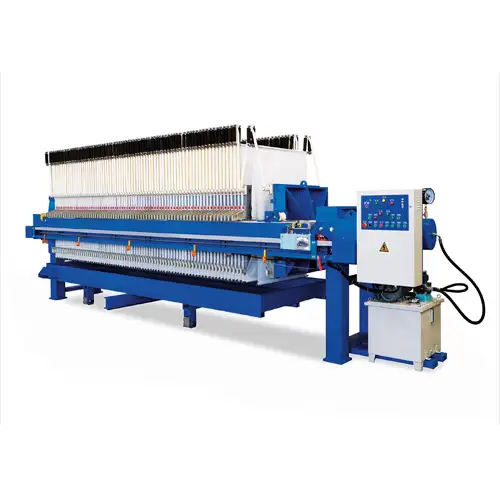
Among these, press filtration systems are widely adopted in heavy industries because they offer high solid capture rates and low residual moisture. This directly reduces waste handling costs and improves water recovery efficiency, especially in high-solids environments.
Solid Liquid Separation in Wastewater Treatment Applications
One of the fastest-growing application areas for solid liquid separation equipment is industrial wastewater treatment. Stricter environmental regulations and rising water costs are forcing factories to rethink how they manage effluent and sludge.
In wastewater treatment, separation equipment is used to:
- Remove suspended solids before discharge
- Dewater sludge to reduce transport and disposal volume
- Recover process water for reuse
- Improve overall treatment efficiency
Modern wastewater filtering solutions focus on reducing operating costs while improving separation performance. Advanced filtration systems now allow plants to handle higher solids loads with lower energy consumption and greater automation. A deeper look at how industries achieve this balance can be found here: wastewater filtering
How Industrial Buyers Evaluate Separation Equipment Performance
From a B2B perspective, the true cost of solid liquid separation equipment extends far beyond the purchase price. Experienced buyers evaluate systems based on total lifecycle value.
Key evaluation criteria include:
- Separation efficiency and cake dryness
- Structural strength and material durability
- Energy consumption per operating cycle
- Ease of maintenance and automation level
- Supplier’s engineering and service capability
Industrial environments are demanding. Equipment must operate continuously, often under high pressure and corrosive conditions. This is why buyers increasingly prefer suppliers with proven manufacturing capabilities and deep application experience rather than generic equipment traders.
Working with experienced industrial filters manufacturers ensures that separation systems are designed for real-world operating conditions rather than ideal laboratory scenarios. Reliable manufacturers understand how material characteristics, process flow, and operating pressure interact over time.
More insight into professional manufacturing capabilities can be found here: industrial filters manufacturers
Automation and Sustainability Trends in Solid Liquid Separation
Automation is transforming how industrial separation systems operate. PLC-controlled filtration, pressure monitoring, and automated cake discharge reduce labor dependence and stabilize performance.
At the same time, sustainability has become a core driver for equipment upgrades. Efficient solid liquid separation reduces water consumption, lowers waste volume, and helps companies meet environmental targets without sacrificing productivity.
Industries that invest in modern separation technology often find that environmental compliance and cost reduction are no longer conflicting goals. Instead, they reinforce each other when the right equipment is selected.
Jingjin: Professional Solid Liquid Separation Solutions for Industry
As a global leader in filtration technology, Jingjin specializes in solid liquid separation equipment designed for demanding industrial applications. With decades of manufacturing experience, Jingjin provides press filtration systems widely used in wastewater treatment, mining, chemicals, metallurgy, and food processing.
Jingjin focuses on robust structural design, high separation efficiency, and long service life. Each solution is engineered to match specific operating conditions, helping industrial customers reduce costs, improve water reuse, and achieve stable, compliant operations worldwide.