


How Can Mining Filtration Improve Processing Efficiency and Sustainability in the Mining Industry?
Jan 21, 2026
Yes—mining filtration plays a pivotal role in improving processing efficiency, reducing water consumption, and lowering overall environmental risk in mining operations. Filtration systems separate valuable minerals from process water and tailings, enabling reuse of water, recovery of valuable solids, and significant cost savings in wastewater treatment and dewatering. Throughout this blog, we’ll explore how mining filtration works, what technologies are most effective, and how decision‑makers can select the right solutions to meet both operational and environmental goals.
What Is Mining Filtration and Why It Matters
Mining filtration refers to the set of technologies and processes used to separate solids from liquids in mining slurry streams. As mineral ores are processed, large volumes of water mixed with fine particles are generated. Efficient filtration systems remove solids so that water can be reused and solids can be handled appropriately.
Inadequate filtration can lead to higher water usage, increased disposal costs, and regulatory challenges related to industrial waste water pollution. Modern filtration solutions are designed to reduce these risks by improving cake dryness, lowering moisture content, and enabling closed‑loop water systems.
Key Technologies in Mining Filtration
There are several filtration technologies used in mining, each with strengths and ideal applications.
Filter Press
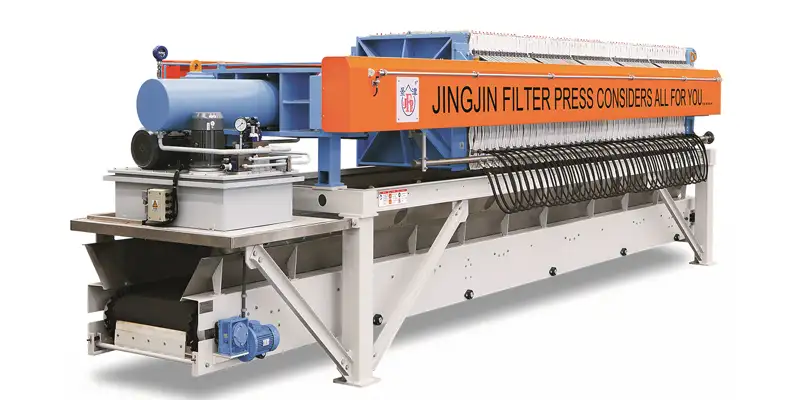
The Filter Press is one of the most widely used filtration systems in mining. It uses pressure to separate solids from liquid by passing slurry through filter cloths housed between rigid plates. The resulting solids (filter cake) can be stacked for further processing or disposal.
Filter presses are known for:
- High solids capture efficiency
- Ability to achieve low moisture content in filter cake
- Scalability for large processing volumes
Vacuum Belt Filters
These systems use vacuum suction beneath a moving filter medium to continuously draw liquid through, leaving solids on the surface. They are useful for certain mineral slurries where continuous operation outweighs batch processing.
Centrifuges
Centrifugal filtration uses rotational force to accelerate sedimentation and separate solids from liquid. These systems work well for fine particles but may be less effective for heavy solids loads compared to press filtration.
How Mining Filtration Fits into the Mineral Processing Flow
Mining filtration is seldom a standalone unit; it’s a critical component of an integrated mineral processing plant.
Pre‑Filtration Conditioning
Before filtration, slurries may be conditioned with flocculants or pH adjustments to improve solids capture. Proper conditioning reduces cloth blinding and improves throughput.
Filtration and Dewatering
The core function of the filtration stage is to remove as much water as possible from solids. Filter presses excel here due to their ability to squeeze tightly packed cakes with minimal residual moisture.
Post‑Filtration Water Recycling
Cleaned water can be reused in processing, reducing freshwater demand and minimizing effluent release. Water recycling is especially important in arid regions or where regulatory frameworks restrict freshwater withdrawal.
Selecting the Right Filtration System for Mining Filtration
Choosing the correct filtration technology depends on several factors:
1. Slurry Characteristics
Particle size, solids concentration, chemical composition, and viscosity all influence filter choice. For fine particles and high solids content, filter presses often deliver the best performance.
2. Desired Cake Moisture Content
Lower moisture solids reduce drying costs and handling expenses. Filter presses typically outperform other methods in producing drier cakes.
3. Processing Volume and Throughput
Large‑scale operations require high‑capacity units or parallel filtration trains. Selecting machinery with scalable plate sizes and automation options can improve uptime.
4. Operational Costs and Maintenance
Consider energy needs, labor intensity, maintenance accessibility, and cloth replacement costs. Some systems offer easy access for cloth cleaning and replacement, reducing downtime.
Comparative Overview of Filtration Technologies
| Filtration Technology | Best Suited For | Cake Moisture Level | Operational Mode |
|---|---|---|---|
| Filter Press | High solids, fine particles | Low | Batch |
| Vacuum Belt Filter | Uniform slurries | Moderate | Continuous |
| Centrifuge | Fine separations | Variable | Continuous |
| Pressure Plate Filter | Moderate loads | Moderate | Batch |
This table helps mining engineers and procurement teams compare common filtration solutions based on performance targets.
Benefits of Effective Mining Filtration
Mining filtration delivers tangible technical and operational benefits:
Reduced Water Consumption
Removing and reusing water cuts operating costs and mitigates environmental impact. Many mining jurisdictions now require water reuse metrics as part of permitting.
Improved Tailings Management
Drier filter cakes are easier to transport, stack, or further process, reducing the footprint and risk of tailings storage facilities.
Lower Environmental Compliance Risk
Efficient separation minimizes the volume of effluent requiring treatment, lowering the cost and complexity of wastewater management.
Operational Efficiency
Integrating automated filtration systems with plant control platforms increases uptime, reduces manual intervention, and improves reliability.
Implementation Considerations in Mining Operations
When incorporating a mining filtration solution, several implementation issues arise:
Site Infrastructure and Footprint
Filter systems require adequate space for units, support equipment, and cake handling/storage. Planning for access, ventilation, and auxiliary water systems is essential.
Integration with Plant Control Systems
Automation, predictive maintenance, and digital monitoring improve performance. Remote diagnostics and sensor integration ensure early identification of issues such as cloth blinding or leaks.
Operator Training and Safety
Highly automated systems still need trained personnel for setup, monitoring, and maintenance. Safety protocols for pressurized systems and heavy equipment must be enforced.
Cost Analysis for Mining Filtration Investments
Initial filtration equipment costs must be weighed against long‑term savings from reduced water use, lower tailings handling costs, and improved operational stability.
Lifecycle Cost Comparison
| Cost Component | Filter Press | Vacuum Belt | Centrifuge |
|---|---|---|---|
| Capital Cost | High | Moderate | High |
| Maintenance | Moderate | High | High |
| Energy Use | Moderate | High | Moderate |
| Water Savings | High | Moderate | Moderate |
This comparison helps procurement teams estimate total cost of ownership, not just upfront capital expenditure.
Contact our mining filtration experts today.
Case Example: Filter Press in a Copper Mine
A large copper mine processing plant needed a robust solution to handle high solids content tailings. After commissioning a multi‑plate filter press, the plant achieved a 30% reduction in moisture content versus its previous vacuum belt filters. This improvement lowered drying costs, freed up water for reuse, and reduced the volume of tailings requiring long‑term storage.
FAQ
Q1: What is the difference between dewatering and filtration?
Dewatering focuses on removing free water from solids, often downstream of primary filtration, which separates liquid from solids in the first place.
Q2: How often do filter cloths need replacement?
Cloth life depends on slurry abrasive characteristics and frequency of cleaning but typically ranges from months to years with proper maintenance.
Q3: Can filter presses operate continuously?
Filter presses work in a batch mode. However, multiple presses used in parallel can achieve near‑continuous operation.
Q4: Are there automated options for mining filtration systems?
Yes, modern systems support PLC/SCADA integration, automated cloth washing, cake discharge mechanisms, and remote monitoring.
About Jingjin
Jingjin is a professional supplier of industrial filtration and dewatering equipment, specializing in custom and standard solutions for mining, chemical, wastewater, and process industries. With deep expertise in filtration engineering and a commitment to quality, Jingjin delivers robust, efficient, and scalable filtration systems that help customers achieve operational excellence, regulatory compliance, and cost‑effective performance.
References
- Wikipedia, Filter press, https://en.wikipedia.org/wiki/Filter_press
- Wikipedia, Nonwoven fabric, https://en.wikipedia.org/wiki/Nonwoven_fabric (relevant background on filtration materials)
- U.S. EPA, Mine Waste Rule and Water Pollution